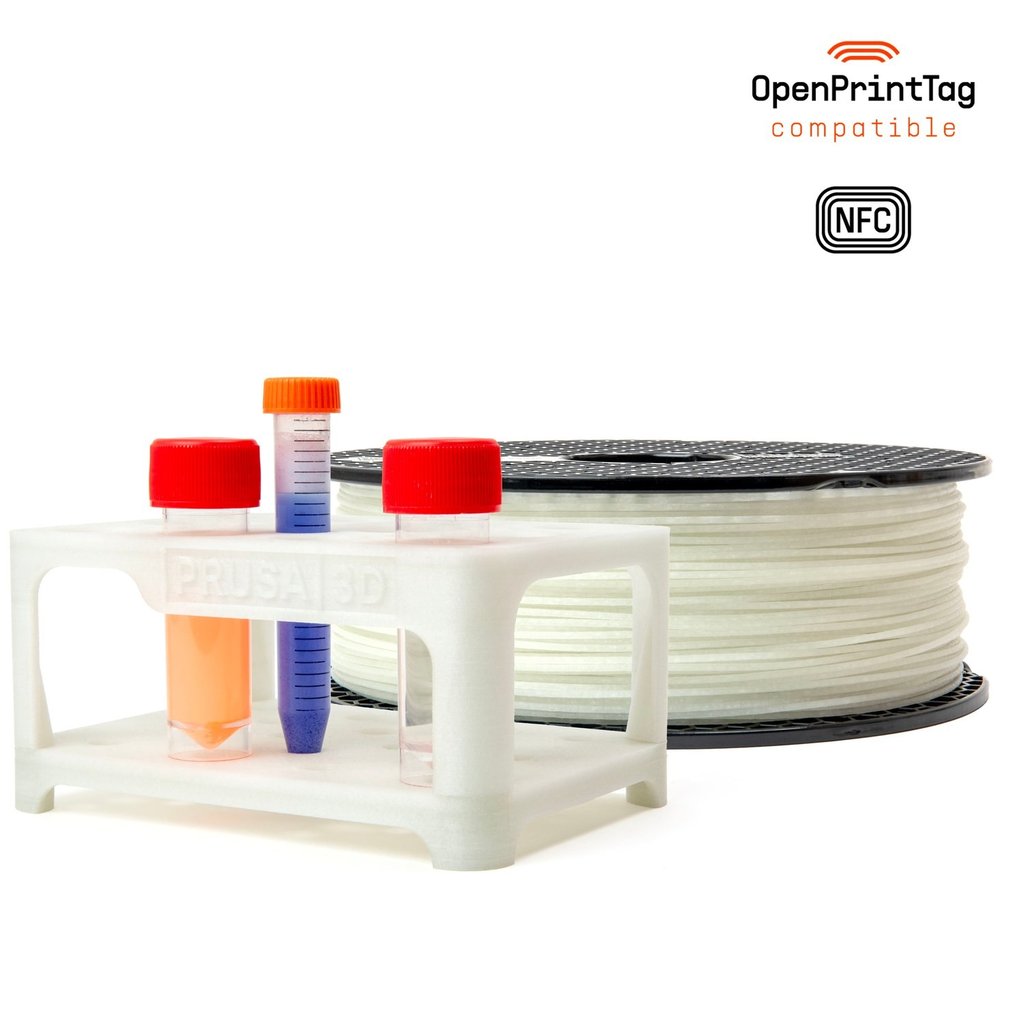
Composite · Glass-fiber reinforced
AdvancedGlass Fiber
GF · PA-GF · PETG-GF · ABS-GF
Glass-fiber-reinforced filaments — added stiffness and dimensional stability across PA, PETG, and ABS bases. Hardened nozzle recommended.
Print temperatures
Nozzle 250–280 °C Bed 80–110 °C
Glass fiber is the more affordable, less brittle cousin of carbon fiber: it stiffens and stabilizes a base resin without carbon's price or extreme brittleness, and it isn't electrically conductive.
The properties depend heavily on the base polymer — GF nylon is a tough engineering material, GF PETG a stiffer functional plastic — but all share the same trade-off: the glass is abrasive, so a hardened nozzle is recommended.
Strengths & trade-offs
- Higher stiffness and dimensional stability than the base resin
- More impact-tough than carbon fiber
- Lower cost than CF composites
- Not electrically conductive
- Good heat resistance (base-dependent)
- Abrasive — hardened nozzle recommended
- More brittle than the unfilled base
- Often hygroscopic (especially GF nylon)
- Needs a larger nozzle
- Properties vary widely by base polymer
Best for
Stiff functional bracketsJigs and fixturesSemi-structural partsToolingCost-sensitive reinforced parts
Did you know
- Glass fiber gives much of carbon fiber's stiffness boost at lower cost — and stays non-conductive.
- A GF composite's real properties come mostly from its base polymer; the glass is the stiffener.